

How Much Money Has Trudeau Given To Alberta
"Today our land is facing a national unity crisis," said Conservative Party of Canada leader Erin O'Toole during an early July spoken language in Alberta. "It'southward time for the unfairness to end. Since 1967, Albertans have contributed more than $600 billion to the rest of Canada … [and] even every bit your economy suffered with massive reductions in resource revenues, you equally Albertans connected to pay more your fair share."
Provincial leaders in Alberta couldn't agree more. "Alberta has been the engine of Canada's prosperity in recent decades," said Alberta's Premier Jason Kenney in a July 15 press briefing. "We have contributed through our federal taxes over $600 billion to the residuum of Canada… only what we find very frustrating is a system that finds u.s.a. contributing on average $twenty billion a year internet through our federal taxes to other provinces even while we have been living through a prolonged recession."
Get our free policy email newsletter.
As Canada moves towards a likely federal election soon, and Alberta towards an Oct referendum on equalization, we're going to hear these figures frequently. But what do they mean? Where do they come from? And are they a sign of unfairness? These are important questions beyond only Alberta and worth exploring in depth.
Using a new interactive data tool from Finances of the Nation, I'll try to explicate.
Alberta's $600 Billion Contribution?
Start, just to exist clear: the more than $600 billion net contribution since the 1960s cited by both Kenney and O'Toole is true. But the full context is ofttimes missing from political speeches.
Luckily, information technology is fairly unproblematic.
The federal government raises revenue from several sources — taxes on incomes, wages, profits, consumption, imports, and so on. The same revenue enhancement rates and schedules use to all of us, but since some Canadians have different incomes, different consumption habits, and and then on, we each pay dissimilar amounts. And since loftier-income people unduly live in some provinces over others, more is raised from those provinces than others.
At the same time, federal spending affects each of u.s.a. differently. Older Canadians receive more transfers than younger (through CPP, OAS, and GIS) and parents more than singles. It might besides depend on where yous live. Halifax residents, for case, benefit significantly from high military spending. Some spending is spread perfectly evenly (such as health and social transfers), and therefore is non redistributive, only these programs are the exception.
Combined, it'due south differences in federal acquirement and spending beyond provinces that redistribute funds. If the federal government raises more per person from some province than elsewhere, that's an outflow; if it spends more per person then elsewhere, that's an inflow; and then on.
These flows tin can exist very large.
Consider Alberta. The federal government raises more revenues from taxpayers residing there than elsewhere and too spends less. I plot this beneath. The gap for 2019 is nigh $twenty billion — just as was cited past Premier Kenney
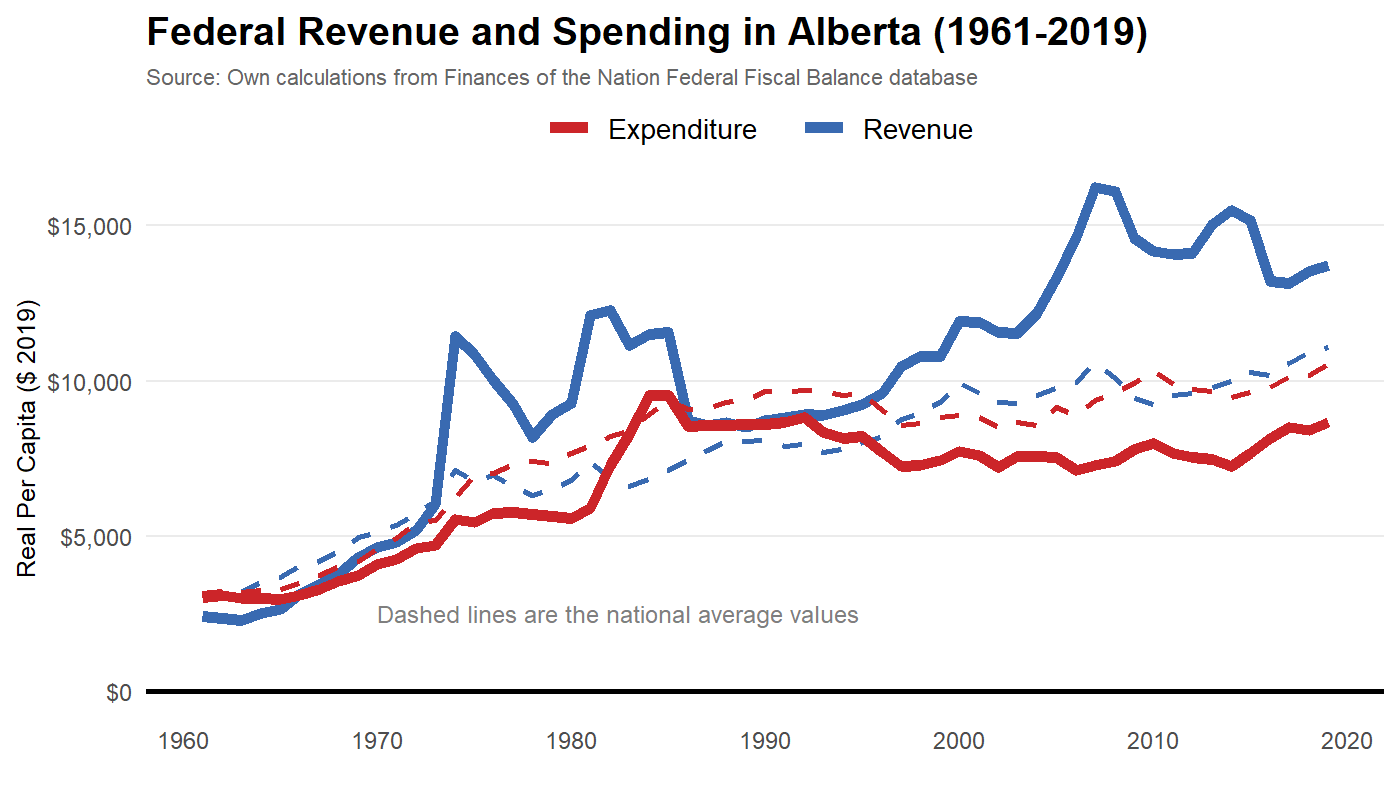
Between 1961 and 2019, this information suggests Alberta's "net contribution" was $622 billion — roughly five pct of its economical activity over the catamenia, equivalent to $3,344 annually per person in today's dollars. Meanwhile, the net contribution by Ontario averaged most 4 percent of its economy ($992 billion or $1,671 per person) and the net inflow to Prince Edward Isle averaged nigh 30 percent (!) of its economy.
(Un)Fairness in the Federation?
Whether this is fair or not depends on the crusade. This is where the new tool actually helps.
Let'due south start with Ontario.
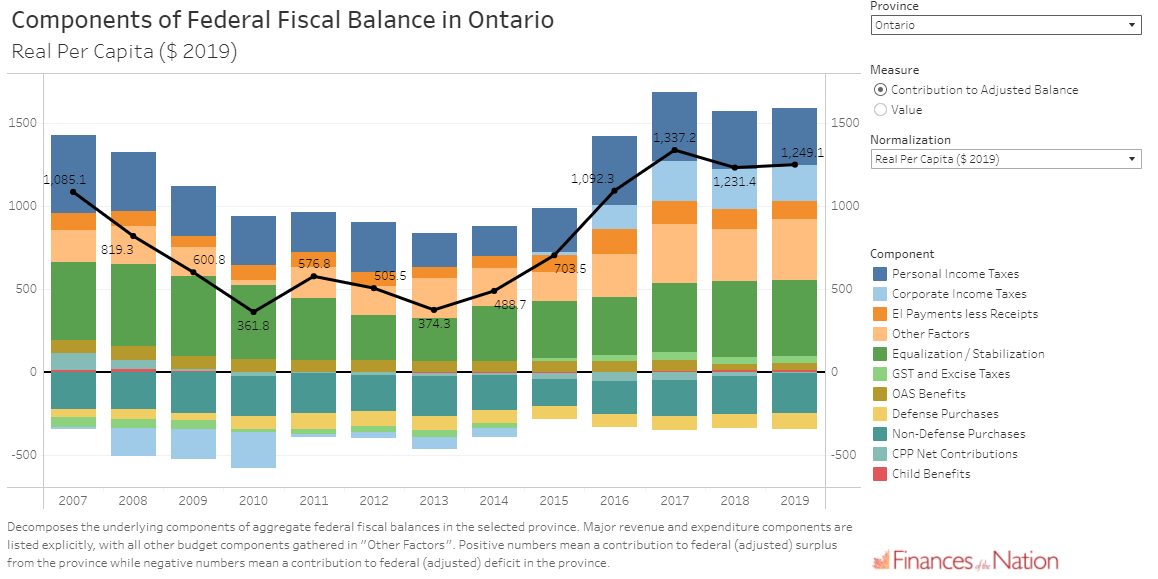
Since a large share of federal activities are in Ottawa, Ontario residents and businesses tend to receive more than in federal spending than elsewhere. That's a negative contribution. Not all spending is high in Ontario, though. Its stiff economy means that it doesn't typically qualify for equalization payments and when it does, such as for the decade post-obit the fiscal crunch, payments are relatively small-scale. That'southward a positive contribution.
On the revenue side, many high-earners live in Ontario, as do many profitable corporations. Federal taxes paid are therefore higher than average. On balance, Ontario is a net "contributor" to federal finances of roughly $18 billion in 2019.
Alberta is a more interesting case. Since 2007, over $328 billion was implicitly redistributed out of the province, that is, over one-half the full transfer since 1961 took place in just the past dozen years and most of this — fully 55 percent — is due to taxes on income, profits and consumption. And eighteen percentage of the net contribution is due to fewer payments to elderly individuals through CPP, OAS, and GIS. This is non because benefit amounts differ but because Alberta is a immature province compared to others.

What about equalization? Redistribution through that program is about as pregnant as the federal GST.
And Alberta'due south recession? Alberta's economy contracted more 20 percent from 2014 to 2016 and its cyberspace contributions barbarous past nearly xl percent. Net contributions through taxes on income, profits, and consumption cruel by more than half. But chiefly, despite its recession average income among Albertans remains higher than any other province — and therefore net contributions go along.
So… is this fair? That's not for me to say. But the aforementioned 5 percentage GST applies in Alberta equally elsewhere, as does the same 15 pct corporate income tax rate and the same income tax schedule for individuals. Identical treatment withal results in redistribution because more loftier income individuals just happen to live in Alberta, and therefore pay more dollars than boilerplate. It's not "Alberta" but high-income Albertans that account for this.
Of course, some adopt lower and flatter federal taxes while others prefer the reverse. Some adopt federal spending be allocated evenly across the country, others prefer it be allocated efficiently and at the to the lowest degree price. Either way, 1 thing is clear, if one is concerned with federal redistribution then a focus on equalization is only a small-scale function of the story. And, importantly, provincial governments practice not themselves transfer annihilation to the federal government or to other provinces.
A Staple of Canadian Politics
Concerns around federal redistribution are neither new nor unique to Alberta conservatives.
Ontario'due south Liberal Premier Dalton McGuinty would regularly blindside a similar drum — citing a $23 billion per year contribution to Canada, and saying it "compromises our ability to invest in Ontario's futurity prosperity" and demanded "Ontario be treated fairly."
Grievances like these even pre-engagement Canada and are an interesting factor backside its very formation. George Dark-brown, an influential politico behind Confederation, alleged to fellow legislators in 1865: "We in Upper Canada have complained that though we paid into the public treasury more than three-fourths of the whole revenue, nosotros had less control over the system of taxation and the expenditure of the public moneys than the people of Lower Canada. Well, sir, the scheme in your mitt [Confederation] remedies that."
I of his primary grievances was Canada West (i.e. Ontario) beingness a "cyberspace correspondent," and separation from Canada East (Québec) and forming a federation was the solution.
So concerns around redistribution and fairness are hither to stay, making information technology important to exist informed. Cutting through the sometimes oversimplified language of politics is never easy. Hopefully this caption and new information helps make some sense of it.
Source: https://thehub.ca/2021-07-26/hub-explainer-albertas-600-billion-federal-contribution-leaves-fairness-in-the-eye-of-the-beholder/
Posted by: martinohaters1968.blogspot.com
0 Response to "How Much Money Has Trudeau Given To Alberta"
Post a Comment